.svg)
Built for clinicians
Everything your clinical experience tells you to ask. Captured before the patient walks in.
Silvia structures everything before the patient sits down - symptoms, history, contraindications, heritage, treatment preferences - and keeps the thread building across every review.
Your triage rules applied automatically.
Every patient.
Every time.
Built to support clinical judgement. Not replace it. Configured by your practice. Applied consistently to every patient.
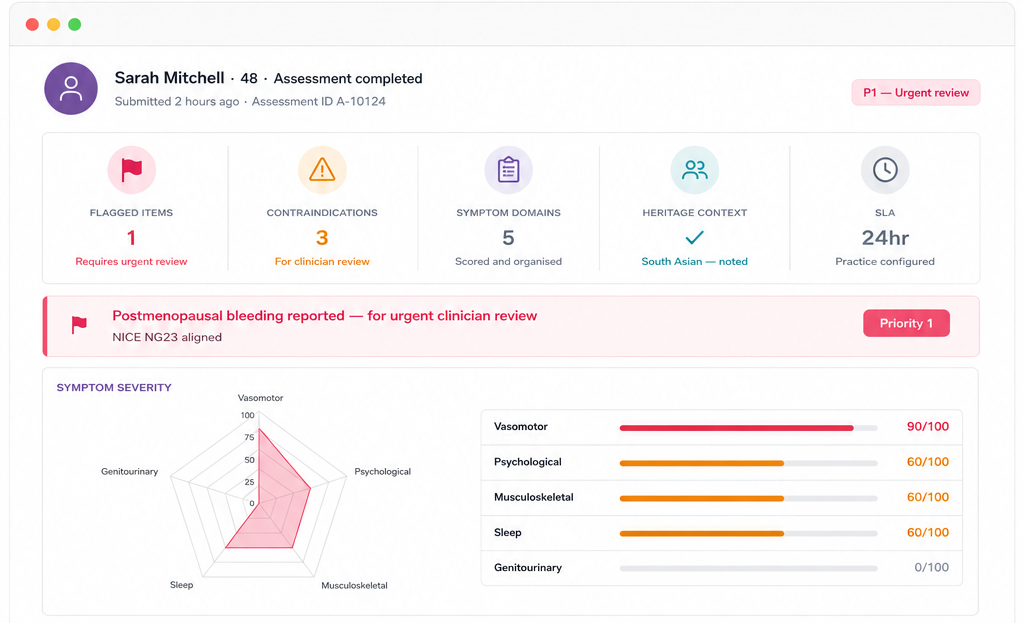
“The structured summary means I can review a patient's full clinical picture in under two minutes. I know what I'm walking into before they sit down.”
Dr Nabeel Arshad - NHS GP Partner, Brooke Surgery
The consultation today
The patient knows more than arrives in the room.
Months of history. Years sometimes. Symptoms building, patterns forming, context accumulating.
You have whatever made it into the record. Whatever gets mentioned in the time available. Whatever surfaces in the notes from last time.
The rest stays in the waiting room. And when the patient comes back, you start piecing it together again.
There's a better way, before the consultation, during it, and between them.
What Silvia captures
Everything your clinical experience tells you to ask. Captured before the patient walks in.
Silvia was built around the clinical reality of menopause care - not just symptoms, but the patient-reported picture across every domain we structure. Structured against NICE NG23. Heritage-informed. Ready before anyone opens the record.
Migraine with aura
Oral HRT - transdermal route preferred
For clinician reviewFamily history of breast cancer
First-degree relative - documented
For clinician reviewHistory of pregnancy hypertension
Cardiovascular risk context noted
For clinician review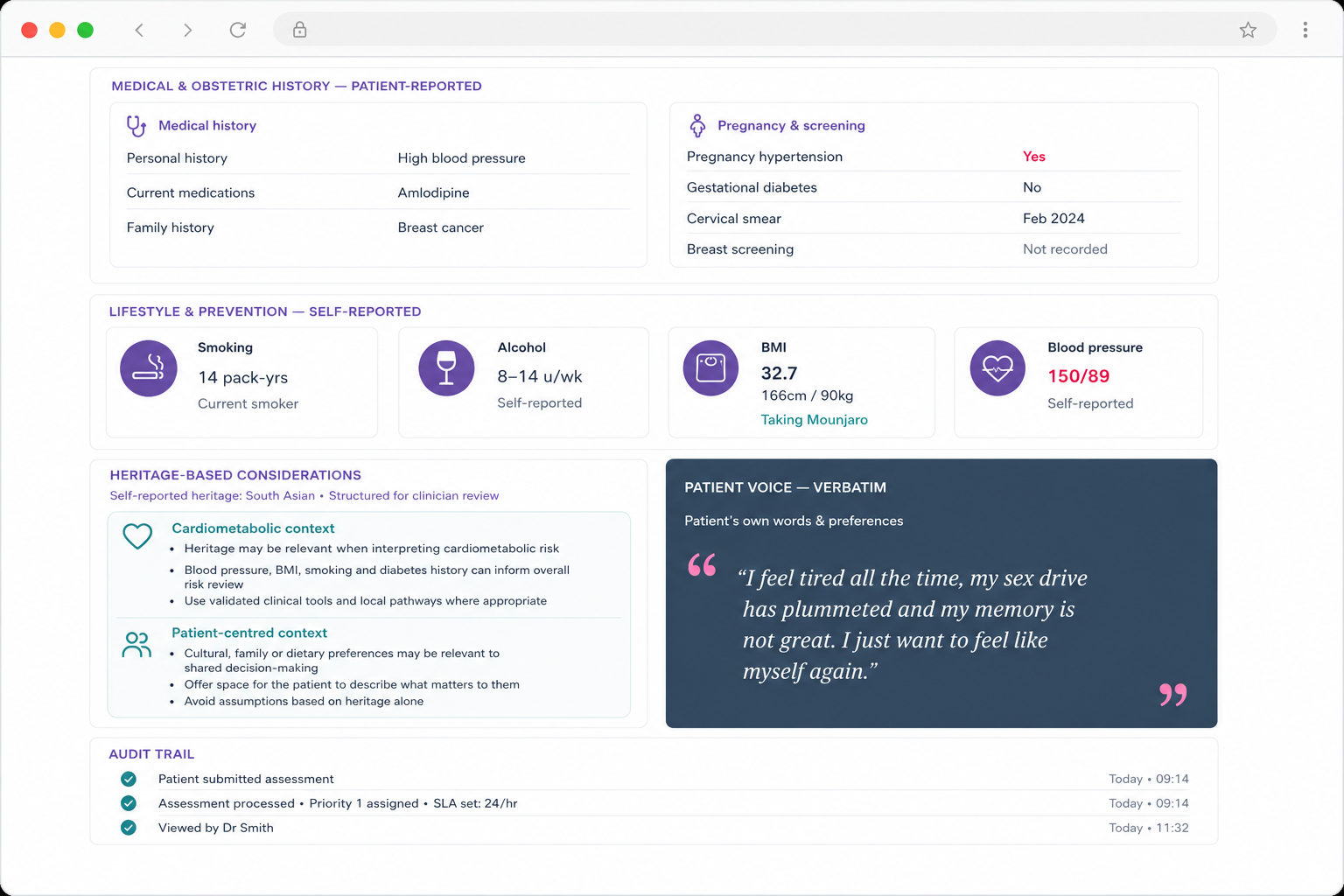
The history that shapes the discussion.
The history that shapes the treatment discussion - there before you walk in.
Patient-reported medical and neurological history captured across the full assessment. Where it corresponds to a contraindication criterion your practice has configured, it's surfaced and labelled for clinician review. Before the consultation begins.
Not buried in notes. Not mentioned as an afterthought. Already there.
Every appointment starts informed.
The thread keeps building. Every appointment starts informed.
At 3, 6, or 12 months - your practice sets the interval - the patient completes a structured check-in. Symptoms reassessed. Treatment response captured. New history documented.
When the patient comes back, you're not starting again. You're continuing.
Practice-configured intelligence
Every practice is different. Silvia works the way yours does.
Silvia doesn't come with a fixed definition of what's urgent, what needs reviewing, or what gets routed where. Your practice defines that - once. Silvia applies it to every assessment, every patient, automatically.
Before Silvia goes live in your practice, you configure your clinical rules once. What's urgent. Who it goes to. What SLA applies. What gets flagged for review. From that point, every patient assessment - whether submitted at 9am or 11pm - runs through exactly those rules. Automatically. Without exception. Without anyone having to remember.
An NHS practice may configure
A private clinic may configure
These are illustrative examples only. Each practice configures its own rules. Silvia applies them. No clinical pathway is recommended by Silvia.
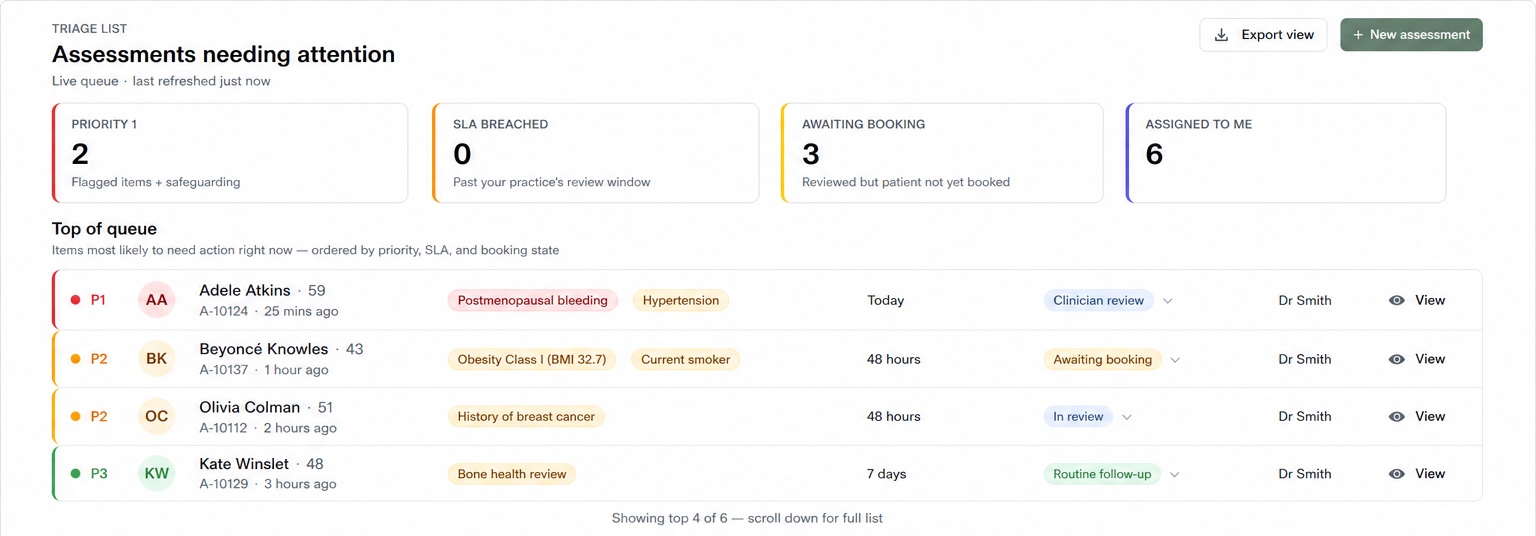
Patient responses match criteria your practice has configured as urgent - surfaced consistently, routed to the right person, with your SLA applied.
→ PRIORITY 1 - Urgent GP review - 24-48hr SLA - practice-configured
Same platform. Completely different configuration.
No black box. No Silvia deciding what matters.
Your clinical logic - applied automatically, to every submission.
What's included
Everything included. Nothing held back.
One product. No tiers. No features held back for a higher plan. Everything below is included, available now via the Early Access Programme.
Structured assessment across every domain.
70+ clinical considerations cross-referenced. Symptoms, history, contraindications, heritage, lifestyle - all captured, organised, and ready before the consultation begins. Structured against NICE NG23. Heritage-informed. Accessible by phone for patients who need it.
Practice-configured triage, routing and SLA rules.
Your practice defines what's urgent, who it goes to, and when. Applied automatically to every assessment, every patient, without exception. NHS practices and private clinics configure it differently. Both get perfect consistency within their own model.
Structured follow-up at 3, 6 or 12 months.
The clinical thread doesn't end at the appointment. Patients complete structured review assessments at intervals your practice sets. Treatment response tracked. New history captured. Every follow-up appointment starts informed.
NICE NG23 aligned. Heritage-informed. Audit trail included.
Every assessment structured against NICE NG23. Heritage-based clinical context for every patient. GMC MAO2012/MAO2024 documentation supported. Full audit trail of every assessment and review.
Which setting?
NHS Primary Care
Built around how your practice works.
Complex patients. Competing appointments. A practice managing menopause care alongside everything else.
Silvia structures the complete assessment before the consultation, applies your triage rules consistently across every patient, and keeps the clinical thread across appointments - whether it's the senior partner or a locum reviewing the queue.
Every patient arrives pre-assessed. Every consultation starts informed.
Private Menopause Clinic
Built for the depth your patients expect.
You have the time to go deep. But without access to the GP record, you're starting from whatever the patient brings with them.
Silvia structures the complete picture before the patient arrives - symptoms, history, contraindications, heritage, treatment preferences - organised and ready before you open the consultation. And when they come back, the thread is updated - not reconstructed.
Every patient arrives pre-assessed. Every appointment starts at depth.
Early Access Programme
See it with your patients in mind.
Silvia is available now via the Early Access Programme - working with a small number of NHS practices and private clinics ahead of full rollout.
If you're managing menopause care and want to see what a fully structured consultation looks like in practice, we'd like to talk.
Silvia is preparing for registration as a Class I medical device with the MHRA. Silvia structures and organises patient-reported information for clinician review. It does not diagnose, recommend treatment, or make clinical decisions. All clinical meaning is assigned by the practice.